July 8, 2026 by Mishael Ochu
Routing Email Operations Through Agent-Ready Infrastructure
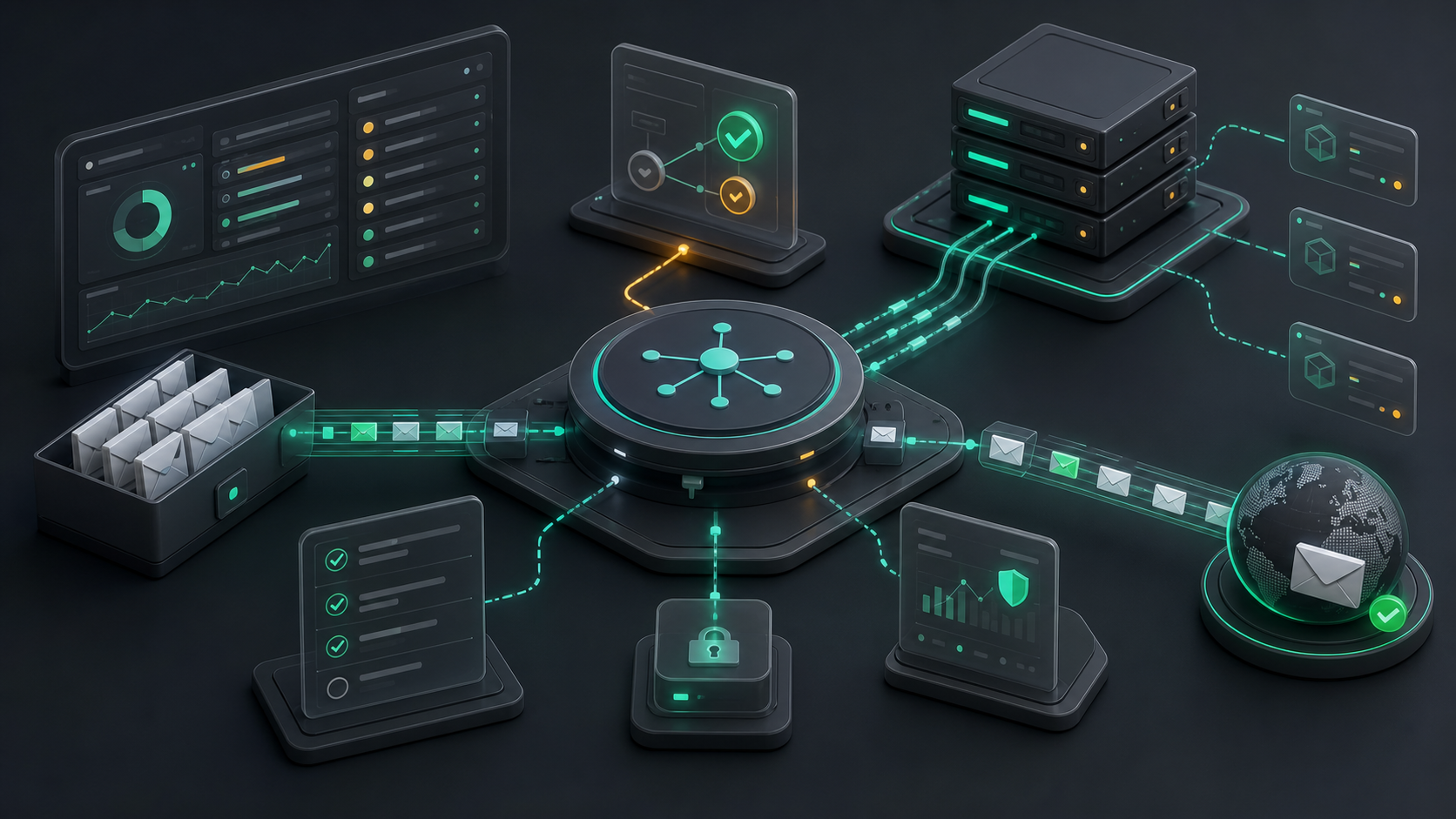
Email as an Operational Workflow
Email usually starts as a utility: send a confirmation, forward a notification, publish a campaign. The trouble is that every new feature wants a slightly different path through the same machinery. One path needs a confirmation token. Another needs a campaign recipient record. Another needs a human to review the content before it leaves.
The Nokware approach is to treat outbound email as an operational workflow instead of a pile of direct SMTP calls.
The Mail-Mgmt Layer
mail-mgmt owns the public-facing pieces:
- Subscribe and unsubscribe endpoints.
- Double opt-in confirmation tokens.
- Contact and list records.
- Campaign drafts, recipient previews, opens, and clicks.
- Public form integration for static sites.
When it has to send a message, it builds a plain structured email request: recipient, sender, subject, and body. In local development, that message lands in an outbox/ folder for inspection. In production, it can register the send with the broader agent router.
The Agent Router Boundary
The router gives mail delivery a clean handoff point. Instead of binding every app to the final mail transport, an app can register a task like:
taskKind: mail-send
source: mail-mgmt
labels: mail-mgmt, email, proton-bridge
That makes the delivery layer swappable. A worker can send through Proton Bridge, a local SMTP relay, or another approved transport without changing the public web app.
Why Agents Belong Near Operations
This is the kind of work where autonomous agents are most useful: structured, auditable, and bounded by clear contracts. The app should not ask an agent to “figure out email.” It should ask the system to perform a specific send task with all the required context attached.
That leaves room for human control where it matters. Campaigns can be drafted, previewed, approved, and then queued. Transactional messages can follow stricter paths. Contact form notifications can be routed immediately.
Local First, Production Later
One practical benefit is that the same code path is testable without sending real mail. Local development writes JSON messages to disk. Production can route through the worker infrastructure. That keeps the workflow inspectable and reduces the chance of accidental sends while the system is still evolving.
The Larger Pattern
The same pattern applies beyond email:
- Let public apps accept requests and validate intent.
- Store enough state to audit the workflow.
- Hand bounded tasks to worker infrastructure.
- Keep humans in control of approvals and sensitive actions.
That is the direction Nokware is taking across internal tools: small services, explicit boundaries, and automation that can be inspected before it acts.
Reliable automation starts with clear handoffs. The clever parts are easier to trust when the boring parts are visible.